Disclaimer
Information provided on this website is general in nature and does not constitute financial advice. Every effort has been made to ensure that the information provided is accurate. Individuals must not rely on this information to make a financial or investment decision. Before making any decision, we recommend you consult a financial adviser to take into account your particular investment objectives, financial situation and individual needs.
A FinSec View – From Oil Shocks to ID Checks: March, Reframed

| 20th March 2026 |
The past few weeks have been a clear reminder of how quickly global events can shift. What began as another geopolitical flare-up has escalated into something far more consequential — influencing markets, supply chains, sentiment and, as anyone who has filled their tank recently will know, everyday confidence.
With so much unfolding, this month’s View opens with a deeper look at the economic implications of the Iran conflict — not to chase the news cycle, but because it sits front-of-mind and the flow-on effects are meaningful.
Closer to home, South Australians head to the polls this weekend in an election shaped far more by cost-of-living pressures than traditional state issues. Both major parties are offering versions of household relief — from downsizer incentives to council-rate caps — at the same time the RBA is tightening nationally. It’s a timely reminder that fiscal and monetary settings don’t always move in the same direction, especially when families are feeling the strain.
Meanwhile, our Partners have just returned from a two day offsite — a chance to step back from the day-to-day, reflect on the year just gone, and set direction for the years ahead. That timing has reinforced something we come back to often: while events can move quickly, good decisions still come from focusing on fundamentals and the longer-term landscape.
Threaded through it all is a simple theme: the tension between confidence, policy and behaviour — and the reminder that in uncertain moments, it’s our response that ultimately shapes the outcome.
In this edition, we also explore the upcoming changes to deeming rates and the Age Pension, a recent Victorian Supreme Court decision that reaffirms the strength of testamentary trusts, and why financial advisers and real-estate professionals are about to start operating a lot more like your bank as new identity-verification laws roll out nationwide.
Let’s get into it.
The Longer View – SPECIAL EDITION

With so much happening, this month’s Longer View is a deeper read — released as a standalone paper. It explores the key economic and market themes behind the Iran conflict, the implications, and a FinSec perspective on what matters most from here.
And for those who prefer the essentials, you’ll find the 5 things that matter most below.
1. This is not a 1970s style oil shock — but confidence is driving volatility.
The disruption at the Strait of Hormuz has hit sentiment faster than supply. Markets are reacting to perceived risk, not a collapse in physical oil availability. That’s why price moves feel sharp, even though global stockpiles remain adequate.
2. Inflation expectations matter more than inflation itself.
Rising oil prices have historically slowed economies in much the same way higher interest rates do — they dampen spending and cool demand. But this cycle is different. We’ve never had an economy with such a large share of retirees and investors relative to traditional borrowers. For many of these households, higher rates actually increase income rather than squeeze it. That means the usual transmission mechanisms of policy and price shocks may not behave as expected, and the balance between slowing consumption and rising investment income becomes far more complex to forecast.
3. Australia feels this through cost pressures, not direct exposure.
We’re a price-taker in global energy markets. Higher fuel and transport costs flow into aviation, freight, supermarkets and small business operations over the coming months.
4. Structural shifts are the real story.
Regardless of how the conflict evolves, underlying trends are accelerating:
- supply chains built for resilience, not efficiency
- rising global insurance and freight costs
- higher baseline inflation as economies duplicate energy systems
- capital flowing into infrastructure, energy security, defence and critical minerals
These will shape the investment landscape far more than week-to-week headlines.
5. For investors, this is a reset — not a derailment.
Volatility was already expected. Diversification is behaving exactly as designed, and long-term themes remain intact. The best approach continues to be:
stay invested, stay disciplined, stay long term.
We’ve chosen not to include our usual Market Update in this edition. With the environment moving as quickly as it is, a month-to-month snapshot risks being more distracting than helpful. For those wanting regular commentary, we provide Weekly Market Updates via our website – the latest can be found here.
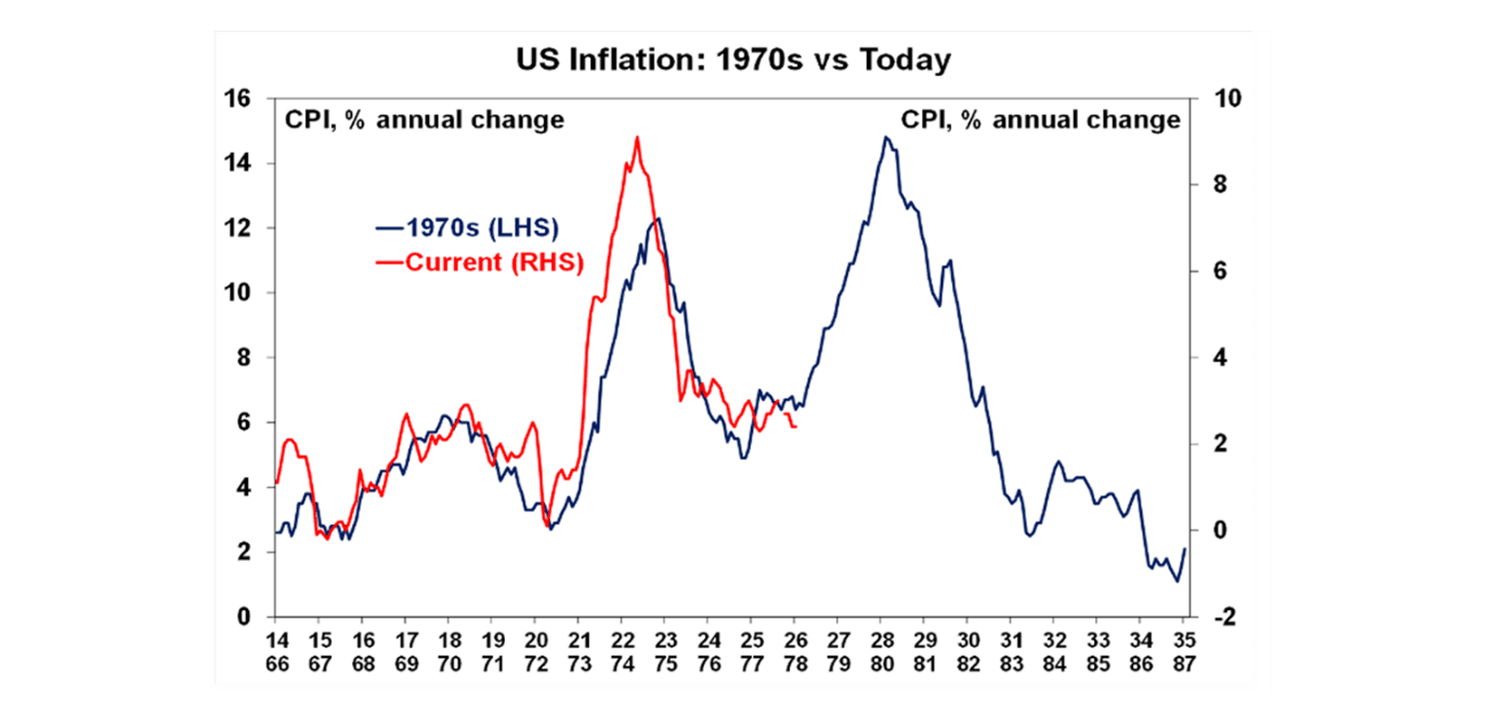
Chart of the Week: When Oil Shocks Don’t Look Like Oil Shocks
Two completely different eras, triggered by completely different forces… yet the inflation pattern rhymes.
That’s what makes this chart so interesting. When you overlay the shape of U.S. inflation during the 1970s oil shocks with the current post-pandemic cycle, the resemblance is striking — even though the causes couldn’t be more different.
Source: AMP Capital
Today’s inflation wasn’t sparked by an oil shortage; it was built on the extraordinary expansion of the monetary base during the pandemic, when governments and central banks moved decisively to support their economies. The recent jump in energy prices is layered on top of that foundation, which is why the pattern looks familiar even if the underlying drivers are not.
This is the point worth highlighting:
History may not repeat itself, but in markets and inflation cycles, it often rhymes.
In the 1970s, inflation surged because barrels physically disappeared from the market. A real supply shock.
Today’s world is very different: we have more producers, more stockpiles, LNG flexibility, and even EV adoption taking some pressure off oil demand. On paper, the system is far more resilient.
So why does it feel like an oil shock anyway?
Because the shock this time isn’t in the barrels — it’s in the psychology.
Markets move long before physical supply does. Insurers pull back, freight spreads widen, algorithms react, social feeds amplify tension… and inflation expectations lift almost instantly.
This doesn’t mean we’re heading for a repeat of the 1970s. Instead, it underlines a broader truth: patterns can look familiar even when the underlying story is different. And in this cycle, psychology—not scarcity—is doing much of the heavy lifting.
Deeming Rates & Age Pension Changes — What Retirees Need to Know

From today (20 March 2026), many retirees will see adjustments to their Age Pension.
Two changes land at once — indexation increases and higher deeming rates.
1. The Pension Is Increasing
Thanks to the latest round of indexation, base pension rates will rise:
- Singles: +$22.20 per fortnight
- Couples: +$16.70 each per fortnight
For full-rate pensioners, this is a straightforward boost.
2. Deeming Rates Are Rising Too
On the same day, deeming rates — the rates Centrelink uses to assume income from financial assets — will increase for the first time since the COVID-19 freeze ended on 30 June 2025:
- Lower rate: 1.25% on the first $64,200 (singles) or $106,200 (couples)
- Upper rate: 3.25% on balances above those thresholds
What This Means in Practice
The interaction of these two changes creates a mixed picture:
- Full pensioners: generally come out ahead
- Income-tested part pensioners: may see the deeming increase offset some (or all) of the indexation uplift
- Recent downsizers or those with higher cash balances: may see larger shifts because more capital is exposed to the new deeming rate
The Hidden Story Behind the Numbers
While the increases reflect rising interest rates and higher cost-of-living pressures, advocacy groups note that not every retiree can easily access higher-yielding savings products. In fact, around one in seven older Australians (a number we think understates the issue) lacks confidence using online banking — which is where most of the best rates now sit.
This means the “average return” assumed by deeming may not match the reality for many retirees.
What You Need to Do
For most people, these changes will be automatic — no forms, no updates required. But if you’re on a part pension or close to an eligibility threshold, it may be worth checking how the new rates interact with your investment balances.
If your payment is affected, the updated amount will appear in your first full payment cycle after 20 March. You’ll be able to view your new rate via MyGov or the Express Plus Centrelink app in late March.
If you’re unsure how these adjustments may affect your entitlements, please contact your adviser to discuss.
In Will Disputes, Need Wins. Every Time.

A recent Victorian Supreme Court case highlights a truth many families find surprising: in estate disputes, financial need — not fairness or years of sacrifice — is what carries weight.
Dr Michelle Wielicki, a GP, spent 17 years caring for her husband after he suffered a severe stroke soon after their wedding. She gradually reduced her work, eventually becoming his full-time carer. When Paul died in 2024, she discovered his will — signed two days after their marriage and never updated — left his entire $1.66 million estate to a testamentary trust for his daughter, from a previous marriage.
Despite her long-term contribution as his carer, the court dismissed her challenge before trial. The reason was simple: with personal assets of around $6 million, she could not demonstrate financial need, the core threshold for a successful family-provision claim.
The case underscores two important lessons:
- A strong estate structure works as intended. Paul’s old will still protected assets exactly as he had arranged.
- Estate planning is not set-and-forget. Life changes, relationships evolve, and intentions shift — but documents only speak to what was true when they were last signed.
For blended families, second marriages or caregiving situations, regular review is essential. A will may still be legally valid, but may no longer reflect your wishes of today.
Estate plans age — intentions evolve. If you’re unsure whether your current arrangements still reflect your wishes, your adviser can help review the structure and connect you with the right legal support.
Why Everyone is About to Ask for your ID (Again)

Australia is rolling out its biggest update to anti-money laundering laws in nearly two decades — changes known as Tranche 2. The goal is simple: lift Australia’s standards to match other developed countries and close the gaps criminals have historically used.
While much of the work happens behind the scenes, clients will notice a few practical differences.
More identity checks — more often
Under the new rules, “gatekeeper” professions — including financial advisers, lawyers, accountants and real-estate agents — must now follow the same level of verification as banks. That means you may be asked for updated ID more frequently, especially if you:
- change your investment approach
- move larger sums
- update trustees or beneficiaries in your SMSF or trust
Trusts will require deeper verification
Because trusts are commonly used in complex financial arrangements, regulators now require verification of everyone involved — not just a trust deed. That can include directors of corporate trustees and, in some cases, beneficiaries which can be tricky when they are minors.
Property transactions will feel different too
If you’re buying property or setting up a new structure, expect all the key professionals involved — from your lawyer to your accountant and adviser — to request the same identification documents. Keeping a digital folder with your ID and trust records will make the process much smoother.
“Source of funds” will matter
For larger transactions, advisers must now understand and document where funds come from. Bank statements, sale records or inheritance documents may be required — a simple “I saved it” won’t meet the new standard.
Why this is happening?
These reforms are designed to protect the financial system, not burden clients. But they do mean more touchpoints and a bit more administration. At FinSec, we’re investing in secure, digital-first identity solutions to make these requirements as simple and safe as possible.
If you are asked by an institution to ID yourself and are unsure about how to proceed, please reach out to the FinSec team.

That’s how much Treasury estimates the current 50% CGT discount will cost the Federal Budget over the next decade.
It’s a big number and the Treasurer is softening us up for some changes in the May budget — but the more interesting part is why it has become a problem?.
The discount was designed with hard assets, like property, in mind which had high entry and exit costs. However the evolution of digital trading of shares at nominal cost has meant that investors could minimise transaction costs, hold an asset for 366 days and access the 50% CGT discount – hardly in the sprit of the law. However, we do view a retrospective change as fundamentally unfair to investors who have made investment decisions within the rules of the day. It will also have a distortionary effect on future sale decisions.
For investors, the takeaway isn’t political; it’s practical:
Tax rules move. Good strategies shouldn’t. Build around what you can control — structure, goals and discipline — not concessions that can change overnight.
Wealth wisdom: The Real Risk in Markets Isn’t Being Wrong — It’s Being Certain

Irving Fisher is remembered today not for being one of the brightest economic minds of his time but for getting one call spectacularly wrong. In October 1929, he famously declared that markets had reached a “permanently high plateau.” Days later, they fell off a cliff.
Most of us would have paused. Fisher didn’t. He doubled down — borrowing heavily to back his conviction. In the end, it wasn’t the forecast that ruined him. It was the certainty.
Markets have a way of humbling even the most brilliant people, and Fisher’s story is the reminder every cycle quietly offers: confidence isn’t the danger — overconfidence is.
It’s easy to fall into. A compelling narrative, a chart that feels “obvious,” a theme that seems unstoppable — certainty creeps in quietly. And that’s when risk rises: positions get bigger, portfolios narrow, and the room for error shrinks.
Humility works differently. It widens the lens. It keeps the door open to alternative outcomes. It builds portfolios designed to absorb surprises rather than deny them.
That’s the real point:
Being wrong is part of investing.
Being certain is where the trouble starts.
In markets like these, a little humility is more than a virtue — it’s one of the most effective risk-management tools you can have.
Friday Funny
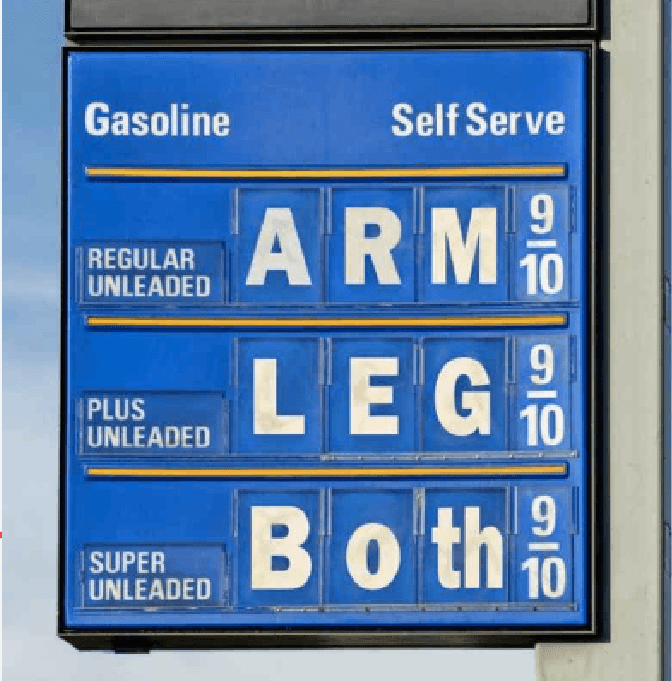
An arm, a leg… and a sense of humour. Because if we don’t laugh, well—let’s not think about it.
Have a great weekend everyone and as always stay safe and look after one another.